

Ultimate Guide to Awash Safari
Find Awash Safari Tours from Verified Ethiopia Operators
The Ultimate Guide to Awash Safari
Awash SafariAwash National Park is one of Ethiopia’s oldest and most iconic protected areas, located at the border of Oromia State and Afar State. Established in 1966, the park covers about 827 km² (319 sq mi), with most of its terrain lying at an altitude of around 900 meters (3,000 ft). Positioned about 225 km east of Addis Ababa, the park stretches across the southern tip of the Afar Region and the northeastern corner of Oromia’s East Shewa Zone.
Renowned for its rich biodiversity, volcanic landscapes, and cultural heritage, Awash National Park is considered a gateway to Ethiopia’s Rift Valley ecosystems.
History
The park was officially designated in 1966, though the legal authorization was finalized three years later. Its creation coincided with the establishment of the Metehara Sugar Plantation to the south. While intended to benefit local communities, the park’s establishment disrupted the livelihoods of the Karayyu Oromo people, who traditionally depended on the land for grazing and subsistence. This tension between conservation and community needs remains part of the park’s legacy.
Geography
Awash National Park is defined by dramatic landscapes shaped by volcanic activity and river systems:
Awash River: Forms the southern boundary, carving deep gorges and creating spectacular waterfalls such as the Awash Falls.
Mount Fentale: A dormant stratovolcano rising to 2,007 m (6,585 ft), dominating the western section of the park.
Illala Saha Plains & Kudu Valley: Separated by the Addis Ababa–Dire Dawa highway, these plains and valleys host diverse wildlife.
Filwoha Hot Springs: Nestled in palm groves along the riverbed, offering a striking oasis in the arid landscape.
The park’s terrain includes acacia woodlands, savannas, thorn bushlands, and wetlands, making it one of Ethiopia’s most ecologically varied reserves.
Ecology
Flora
Vegetation is classified into four main ecosystems:
Arid Acacia woodlands
Thorn bushlands
Savanna grasslands
Riverine wetlands
Unique plants such as doum palms and desert date trees thrive around Filwoha and Doho, creating niches for mammals, reptiles, and birds.
Fauna
Awash National Park is home to 81 mammal species and 43 reptile species. Notable wildlife includes:
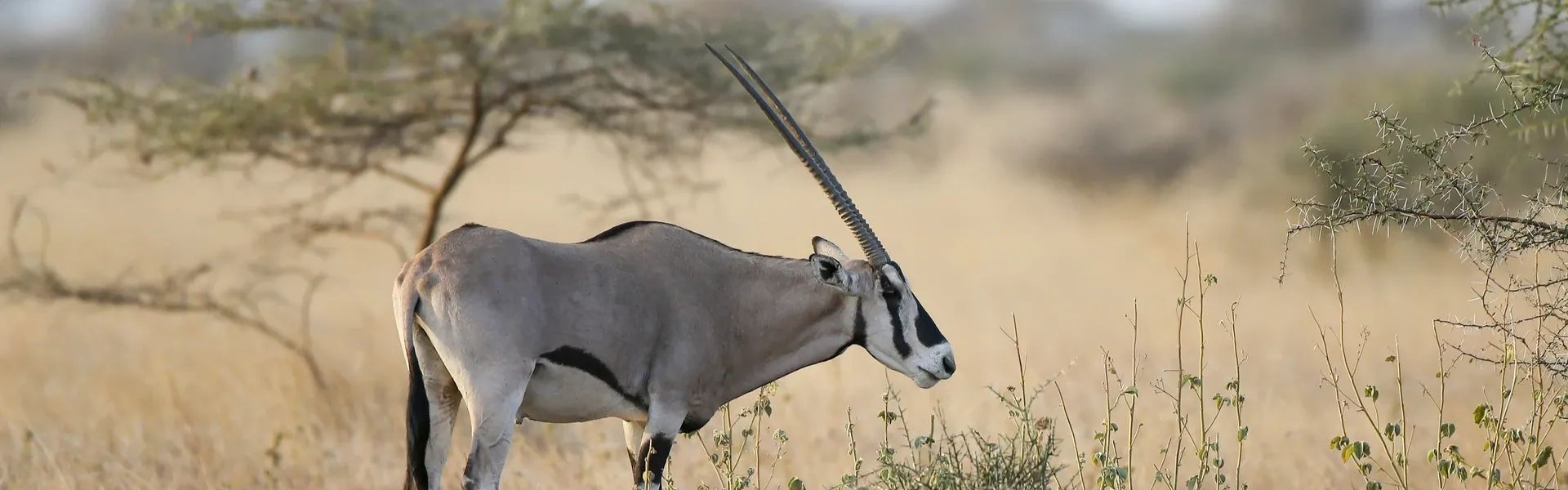
Beisa oryxes, Soemmerring’s gazelles, greater and lesser kudus, warthogs, reedbucks, and klipspringers.
Predators such as lions, leopards, cheetahs, caracals, servals, hyenas, and jackals.
Primates like olive baboons, guerezas, grivets, and hamadryas baboons, which are abundant throughout the park.
Rare species such as Swayne’s hartebeest, once translocated here, though their current status is uncertain.
Reptiles include Nile crocodiles in river valleys, rock pythons in wetlands, and venomous snakes such as black mambas, puff adders, and spitting cobras. Smaller reptiles like geckos, skinks, and agamas are also common.
Avifauna
With 453 bird species, Awash is a birdwatcher’s paradise. Highlights include:
Somali ostriches, kori bustards, Abyssinian rollers, ground hornbills, bee-eaters, and vultures.
Endemic species such as the wattled ibis, black-winged lovebird, banded barbet, yellow-throated seedeater, Abyssinian woodpecker, white-billed starling, and thick-billed raven.
Activities
Visitors to Awash National Park can enjoy:
Wildlife Viewing: Spotting oryxes, gazelles, predators, and primates.
Birdwatching: Observing endemic and migratory species.
Trekking & Hiking: Exploring Mount Fentale and the Awash River gorge.
Hot Springs Exploration: Relaxing at Filwoha’s palm-shaded geothermal pools.
Photography: Capturing waterfalls, volcanic landscapes, and diverse wildlife.
Conservation & Challenges
Awash National Park faces several challenges:
Community Conflicts: The displacement of the Karayyu Oromo people has created ongoing tensions.
Habitat Loss: Expansion of agriculture and grazing pressures threaten ecosystems.
Wildlife Decline: Elephants, rhinos, zebras, and Cape buffalo once roamed here but have been extirpated due to hunting and habitat degradation.
Despite these challenges, the park remains a cornerstone of Ethiopia’s conservation network, protecting unique Rift Valley biodiversity.