
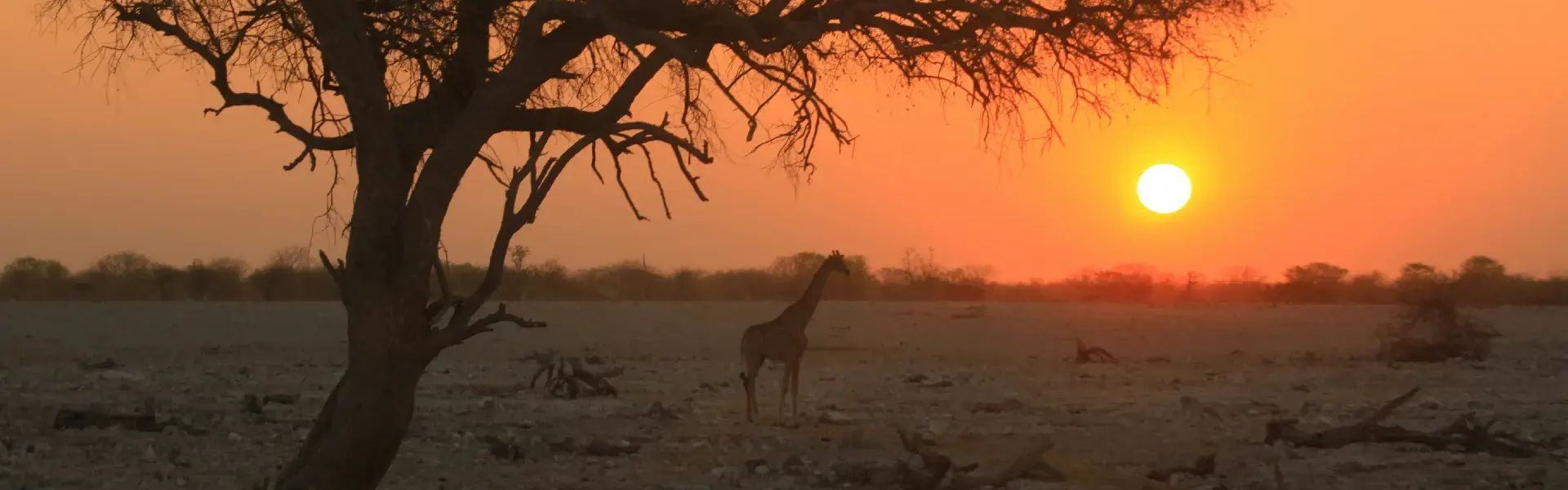

Ultimate Guide to Etosha Safari
Find Etosha Safari Tours from Verified Namibia Operators
The Ultimate Guide to Etosha Safari
Magnificent Namibia National Parks
Etosha National Park, located in northwestern Namibia, is one of Africa’s largest and most iconic wildlife reserves. Spanning 22,270 square kilometres, it is named after the vast Etosha Pan, a salt flat that covers nearly a quarter of the park. Established as a game reserve in 1907 and later upgraded to national park status in 1967, Etosha is renowned for its dramatic landscapes, rich biodiversity, and role as a global stronghold for the endangered black rhinoceros.
History
The park’s origins trace back to German colonial rule when Governor Friedrich von Lindequist proclaimed it a reserve in 1907. Over time, boundaries shifted significantly, reducing its size from nearly 80,000 square kilometres to its current extent. The Hai||om people, original inhabitants of the pan area, were forcibly removed in 1954, though their cultural ties remain acknowledged today. Etosha has witnessed colonial conflicts, wildlife culling during droughts, and conservation milestones such as the establishment of the Etosha Ecological Institute in 1974. In recent years, challenges like poaching and wildfires have tested its resilience, but restoration and protection efforts continue.
Geography
The defining feature is the Etosha Pan, a 5,000 square kilometre salt flat that alternates between barren dryness and shallow seasonal flooding. During wet months, it attracts flamingos and pelicans, while in dry seasons saline dust enriches soils downwind. The park also includes dolomite hills, savanna woodlands, mopane forests, and thorn bush savannas. Its climate is semi‑arid, with scorching summers reaching 40 °C and cooler winters averaging 10 °C at night.
Ecology
Etosha’s vegetation is diverse, ranging from mopane woodlands (covering 80% of the park) to halophytic grasses around the pan. Acacia and Terminalia trees dominate sandveld areas, while dwarf shrub savannas and thorn bush savannas thrive near alkaline soils. This mosaic of habitats supports a wide variety of herbivores and predators, making Etosha one of Africa’s premier wildlife viewing destinations.
Wildlife
Etosha hosts 114 mammal species, 340 bird species, and over 100 reptile species. Elephants here are the tallest in Africa, though their tusks are unusually short due to mineral deficiencies. Lions, leopards, cheetahs, hyenas, giraffes, zebras, springbok, kudu, and gemsbok are commonly seen. The park is the world’s most important custodian of black rhinos, though poaching remains a serious threat. Flamingos, pelicans, cranes, and ostriches add to its avian diversity, while rarities such as the Damara dik‑dik and black‑footed cat highlight its ecological richness.
Surrounding Areas
Etosha lies within the Kunene Region, bordered by Oshana, Oshikoto, and Otjozondjupa. Key entry points include Okaukuejo, Namutoni, and Halali camps, which serve as hubs for tourism and research. The park is part of Namibia’s broader conservation network and contributes to regional wildlife corridors.
Activities
Game Drives: Spot elephants, lions, rhinos, and antelopes at waterholes and across savannas.
Birdwatching: Observe flamingos, pelicans, and raptors around the pan and floodplains.
Photography: Capture dramatic salt flats, dolomite hills, and wildlife interactions.
Cultural Encounters: Learn about the Hai||om people’s heritage and ties to the land.
Research Visits: Explore the Etosha Ecological Institute’s contributions to conservation science.
Best Time to Visit
Dry Season (May–October): Wildlife congregates at waterholes, offering excellent viewing.
Wet Season (November–March): The pan fills with water, attracting migratory birds and lush scenery.
Transitional Months (April, early November): Balanced conditions with fewer tourists and unique photographic opportunities.
Visitor Tips
Access: Main gates include Anderson (south), Von Lindequist (east), and Galton (west).
Vehicles: A 4x4 is recommended for remote areas, though main roads are accessible.
Accommodation: Camps like Okaukuejo, Namutoni, and Halali provide lodging and facilities.
Supplies: Carry essentials, as distances between camps are long.
Clothing: Light wear for hot days, warm layers for cool nights, and sun protection.
Safety: Respect park rules, avoid leaving vehicles outside designated areas, and be cautious near wildlife.