

Ultimate Guide to Augrabies Falls Safari
Find Augrabies Falls Safari Tours from Verified South Africa Operators
The Ultimate Guide to Augrabies Falls Safari
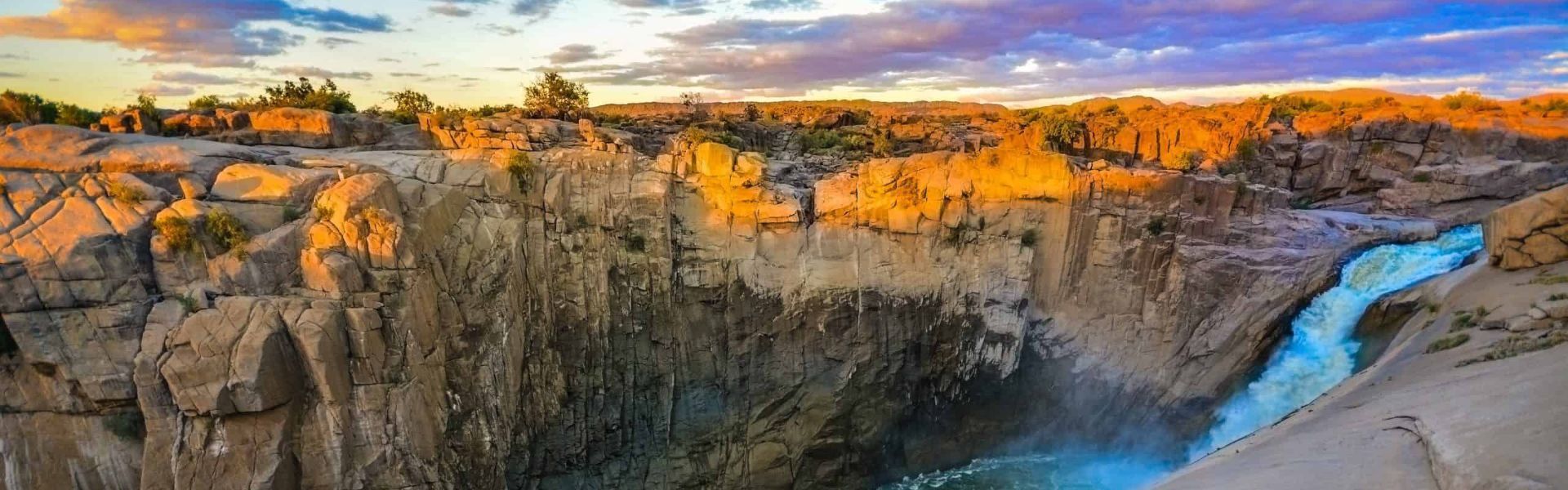
Augrabies Falls SafariAugrabies Falls National Park, located about 120 km west of Upington in South Africa’s Northern Cape Province, is one of the country’s most dramatic natural landmarks. Covering 820 km² (320 sq mi) along the Orange River, the park is defined by its arid landscapes and the spectacular Augrabies Falls, a waterfall about 60 m (200 ft) high. Below the falls lies a gorge averaging 240 m deep and stretching for 18 km, carved into granite by centuries of erosion. The park was officially established in 1966 and remains a popular destination for nature lovers and adventurers.
History
The original Khoekhoe people named the waterfall Ankoerebis, meaning “place of great noise,” reflecting the thunderous sound of water crashing into the gorge. Later, Khoi and San communities settled in the area, living in traditional matjiehuise (mat houses), which cleverly adapt to both hot and cold climates. The name “Augrabies” was derived by Trekboers who later settled in the region. Legends persist that the swirling granite pools at the base of the falls conceal one of the world’s largest caches of diamonds, carried downstream by the Orange River.
Ecology
The park lies within the Nama-Karoo biome, a semi-desert region with rocky outcrops and sparse vegetation. The most iconic plant is the giant quiver tree (Aloidendron dichotomum), locally called kokerboom. Growing up to five meters tall, it is perfectly adapted to the harsh climate. Historically, the San people used its hollow branches to make arrow quivers. Other notable vegetation includes the Shepherd’s tree, revered by Khoi and San communities, and smaller shrubs adapted to arid conditions.
Fauna
Augrabies supports a variety of wildlife across its 28,000 hectares. Common species include springbok, gemsbok, and the endangered south-central black rhinoceros. Smaller predators such as black-backed jackal, caracal, bat-eared fox, and African wildcat roam the park. Rare species like the Cape clawless otter inhabit the river systems. Reptiles include the Nile monitor lizard, Africa’s largest lizard. Birdlife is abundant, with species such as the Namaqua sandgrouse and double-banded sandgrouse thriving in the dry environment.
Landmarks
One of the park’s most striking features is Moon Rock, a massive exfoliation dome measuring 700 m by 100 m and rising 30 m high. It offers panoramic views of the surrounding arid landscape. The gorge and granite formations provide a dramatic backdrop to the falls, especially during flood season when the Orange River is at its most powerful.
Activities
Visitors to Augrabies can enjoy:
Viewing Augrabies Falls – spectacular during floods.
Night Drives – spotting nocturnal wildlife.
Dassie Trail – a 5 km self-guided hike.
Klipspringer Trail – a 3-day, 14.4 km hike through rugged terrain.
Wildlife Viewing – springbok, gemsbok, and smaller predators.
Photography – capturing dramatic landscapes and unique flora.
Best Time to Visit
The park can be visited year-round, but the rainy season (January to April) brings the most dramatic views of the falls, as the Orange River floods. The dry season (May to October) offers easier hiking conditions and clearer skies for photography.
Visitor Tips
The park is about 8 hours from Cape Town and 10 hours from Johannesburg by road.
Carry sufficient water and sun protection, as the climate is extremely arid.
Hiking trails are self-guided and well-marked, but require good fitness.
Respect cultural traditions and natural landmarks, especially the revered quiver and Shepherd’s trees.
Plan visits during flood season for the most awe-inspiring waterfall views.