

Ultimate Guide to Golden Gate Safari
Find Golden Gate Safari Tours from Verified South Africa Operators
The Ultimate Guide to Golden Gate Safari
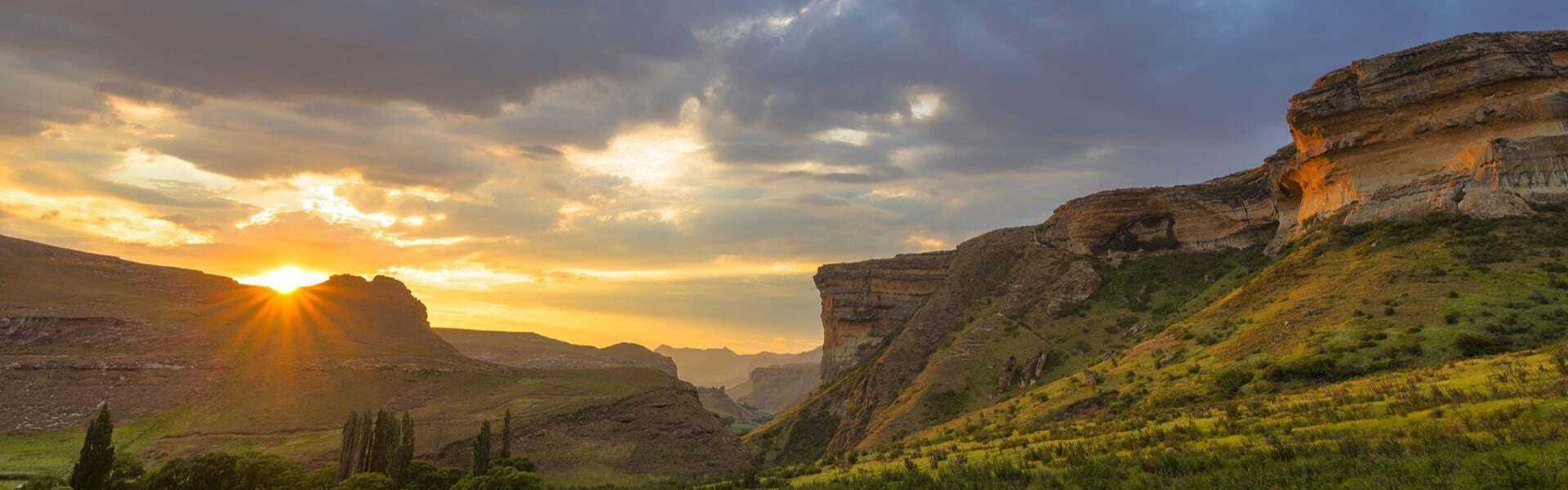
Golden Gate SafariGolden Gate Highlands National Park, located in the Free State province of South Africa near the Lesotho border, is one of the country’s most striking natural reserves. Covering 340 km² (130 sq mi), it is the only national park in the Free State, renowned more for its breathtaking landscapes than for its wildlife. The park’s name comes from its golden, ochre, and orange-hued sandstone cliffs, which glow spectacularly in the setting sun. The most famous landmark is Brandwag Rock, a towering sandstone outcrop that dominates the skyline.
The park is also rich in cultural and scientific heritage, with San rock paintings preserved in caves and shelters, and numerous palaeontological discoveries, including dinosaur eggs and skeletons. These features make Golden Gate Highlands a destination that blends natural beauty, history, and science.
History
The name “Golden Gate” was coined in 1875 by farmer J.N.R. van Reenen, who was inspired by the golden rays of the sun illuminating the cliffs. The park was first proclaimed in 1963, covering 47.92 km², specifically to protect its scenic beauty. Over the years, it expanded: in 1981 to 62.41 km², in 1988 to 116.33 km², and finally in 2007, when it merged with the neighboring QwaQwa National Park, reaching its current size of 340 km².
Geography and Climate
Golden Gate lies in the Rooiberge of the eastern Free State, in the foothills of the Maluti Mountains. The Caledon River forms its southern boundary, which also marks the border with Lesotho. Elevation ranges from 1,800 m (5,900 ft) plateaus in the north to 2,700 m (8,900 ft) in the south, with the highest peak, Ribbokkop, rising to 2,829 m (9,281 ft) the tallest point in the Free State.
The park experiences a highveld climate: dry, sunny winters with occasional heavy snowfalls, and summer months (October–April) marked by showers, hail, and thunderstorms. Average annual rainfall is about 800 mm (31 in), sustaining its grasslands and montane flora.
Vegetation
Golden Gate is a haven for highveld and montane grassland flora, with more than 60 grass species and a wide variety of bulbs and herbs. Seasonal flowering ensures colorful veld displays throughout summer. The park also contains Afromontane forests and rare Austro-Afro alpine grasslands, scarce in South Africa.
The ouhout (Leucosidea sericea) is the most common tree, supporting over 117 beetle species. Exotic species like wattle and bluegum are systematically eradicated, while culturally significant trees such as Lombardi poplars and weeping willows are preserved.
Wildlife
Although not a “Big Five” destination, Golden Gate supports diverse wildlife:
Mammals – eland, black wildebeest, blesbok, Burchell’s zebra, springbok, mountain reedbuck, oribi, chacma baboon, and grey rhebok.
Birds – over 210 species, including the rare bearded vulture, endangered Cape vulture, bald ibis, blue crane, secretary bird, and Verreaux’s eagle.
Reptiles and Amphibians – seven snake species, including puff adder, mountain adder, and rinkhals.
Fish – carp, rainbow trout, and chubbyhead barb in rivers and dams.
The park also reintroduced species such as the sungazer lizard and water mongoose, emphasizing conservation of smaller, unique animals.
Geology and Palaeontology
Golden Gate offers textbook examples of southern Africa’s geological history. The sandstone formations belong to the Karoo Supergroup, deposited during the late Triassic Period when the region was a desert of dunes and oases. Around 190 million years ago, volcanic lava flows covered the desert, forming the Drakensberg basalt summits.
Visible formations include:
Molteno Formation – oldest layer.
Elliot Formation – red mudstone rich in dinosaur fossils.
Clarens Formation – yellow-brown sandstone cliffs, including Brandwag.
Drakensberg Formation – basaltic lava forming mountain summits.
In 1978, the oldest known dinosaur embryos were discovered here, fossilized within eggs of Massospondylus, a prosauropod dinosaur. Other fossils include cynodonts, thecodonts, and bird-like dinosaurs, making the park a globally significant palaeontological site.
Activities
Visitors to Golden Gate can enjoy:
Scenic Drives – exploring sandstone cliffs and valleys.
Hiking Trails – including the Ribbok Trail, offering views of Ribbokkop.
Wildlife Viewing – spotting antelope, zebras, and birdlife.
Basotho Cultural Village – experiencing traditional huts, crafts, and heritage.
Photography – capturing golden sandstone cliffs at sunrise or sunset.
Accommodation
Accommodation is available at:
Glen Reenen Rest Camp – caravan and campsites with amenities.
Brandwag Rest Camp – chalets near Brandwag Rock.
Golden Gate Hotel – refurbished and managed separately by SANParks.
Nearby towns include Clarens (17 km west) and Phuthaditjhaba, both easily accessible by tarred roads.
Best Time to Visit
Golden Gate is spectacular year-round:
Summer (October–April) – lush grasslands, wildflowers, and thunderstorms.
Winter (June–August) – dry, sunny days with occasional snowfalls, offering dramatic landscapes.
Visitor Tips
Visit Brandwag Rock at sunset for iconic golden views.
Explore the Valley of Desolation and sandstone formations for geology enthusiasts.
Carry warm clothing, as temperatures can drop sharply, especially in winter.
Respect cultural sites and San rock paintings.
Combine a visit with nearby Clarens, known for art galleries and restaurants.