

Ultimate Guide to Garden Route Safari
Find Garden Route Safari Tours from Verified South Africa Operators
The Ultimate Guide to Garden Route Safari
Garden Route SafariGarden Route National Park, proclaimed on 6 March 2009, is one of South Africa’s most diverse and scenic reserves. Stretching across the Western Cape and Eastern Cape provinces, it was created by amalgamating the Tsitsikamma National Park, Wilderness National Park, the Knysna National Lake Area, and several other state-owned lands. Covering about 1,210 km² (470 sq mi), the park includes approximately 605 km² (234 sq mi) of continuous indigenous forest, making it one of the largest protected forest complexes in southern Africa.
The park is celebrated for its dramatic coastline, lush forests, estuaries, lakes, and fynbos vegetation, and is home to the famous Otter Trail, one of South Africa’s premier hiking routes. Its climate is unique in Africa, as it is the only region where rainfall occurs throughout the year, creating a temperate environment that supports exceptional biodiversity.
History
The Garden Route National Park was established to unify fragmented conservation areas into a single, continuous ecological corridor. This consolidation ensured better protection of forests, wetlands, and marine ecosystems while promoting sustainable tourism. The park’s creation was part of a broader vision to safeguard the Cape Floristic Region, a UNESCO World Heritage Site known for its extraordinary plant diversity.
Ecology
The park encompasses a mosaic of ecosystems:
Indigenous Forests – dense, ancient forests with yellowwoods, stinkwoods, and ironwoods.
Fynbos Vegetation – unique shrubland with thousands of endemic species.
Wetlands and Estuaries – vital habitats for fish, amphibians, and birdlife.
Marine Ecosystems – rocky shores, sandy beaches, and coastal waters rich in marine life.
This ecological diversity supports a wide range of species, from large mammals to rare birds and marine organisms.
Fauna
Wildlife in the Garden Route National Park includes bushbuck, vervet monkeys, baboons, and smaller antelope. Birdlife is prolific, with species such as the Knysna turaco, African fish eagle, and kingfishers thriving in forest and wetland habitats. The marine environment supports dolphins, seals, and seasonal whale migrations.
Sections
Tsitsikamma Section
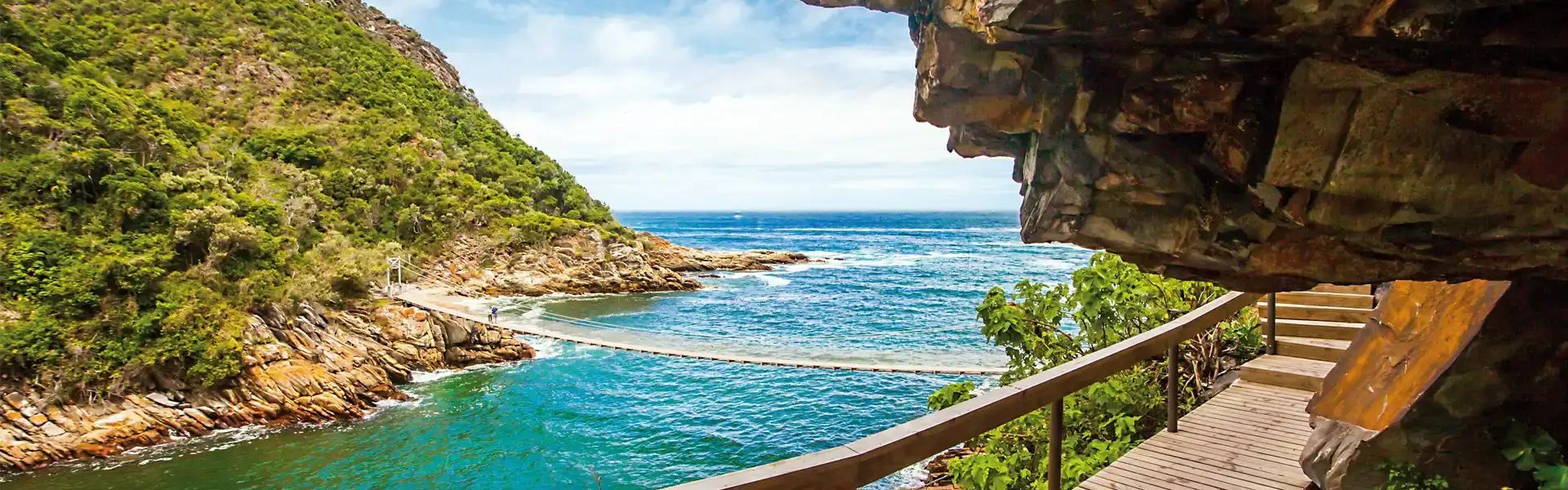
The Tsitsikamma section covers an 80 km stretch of coastline, with Nature’s Valley at its western end. It is renowned for its indigenous forests, rugged cliffs, and the Otter Trail, which offers multi-day hikes along the shoreline. The Storms River Mouth is the main visitor hub, featuring accommodation and dramatic views of waves crashing against cliffs. Nearby, the Bloukrans Bridge hosts the world’s highest commercial bungee jump at 216 m (709 ft).
Wilderness Section
The Wilderness section lies around the seaside town of Wilderness, between George, Sedgefield, and Knysna. It protects a network of rivers, lakes, and estuaries, including the Touw River, Swartvlei estuary, and the Serpentine waterway. This section conserves three major forest zones, four types of fynbos, and several archaeologically significant sites. The Ebb and Flow Rest Camp is a popular base for exploring the area.
Knysna Section
The Knysna National Lake Area protects the famous Knysna estuary and lagoon, one of South Africa’s most important coastal wetlands. It is home to the endangered Knysna seahorse, found only in this lagoon and two other locations. The estuary supports rich birdlife and is a hub for water-based recreation.
Activities
Visitors to Garden Route National Park can enjoy:
Hiking – including the world-famous Otter Trail and shorter forest walks.
Birdwatching – spotting forest, wetland, and coastal species.
Water Activities – canoeing, kayaking, and boating in rivers and lagoons.
Adventure Sports – bungee jumping at Bloukrans Bridge and ziplining in Tsitsikamma.
Scenic Drives – exploring coastal roads and viewpoints.
Cultural Exploration – visiting archaeological sites and learning about indigenous heritage.
Best Time to Visit
The park’s year-round rainfall makes it accessible in all seasons. Summer (November–March) offers warm weather for beach and water activities, while winter (May–August) provides cooler conditions ideal for hiking and forest exploration. Whale watching is best between June and November along the Tsitsikamma coast.
Visitor Tips
Base yourself at Storms River Mouth, Ebb and Flow Rest Camp, or Knysna for easy access to different sections.
Book the Otter Trail well in advance, as it is highly popular.
Carry rain gear, as showers can occur at any time of year.
Respect conservation rules, especially in sensitive forest and wetland areas.