
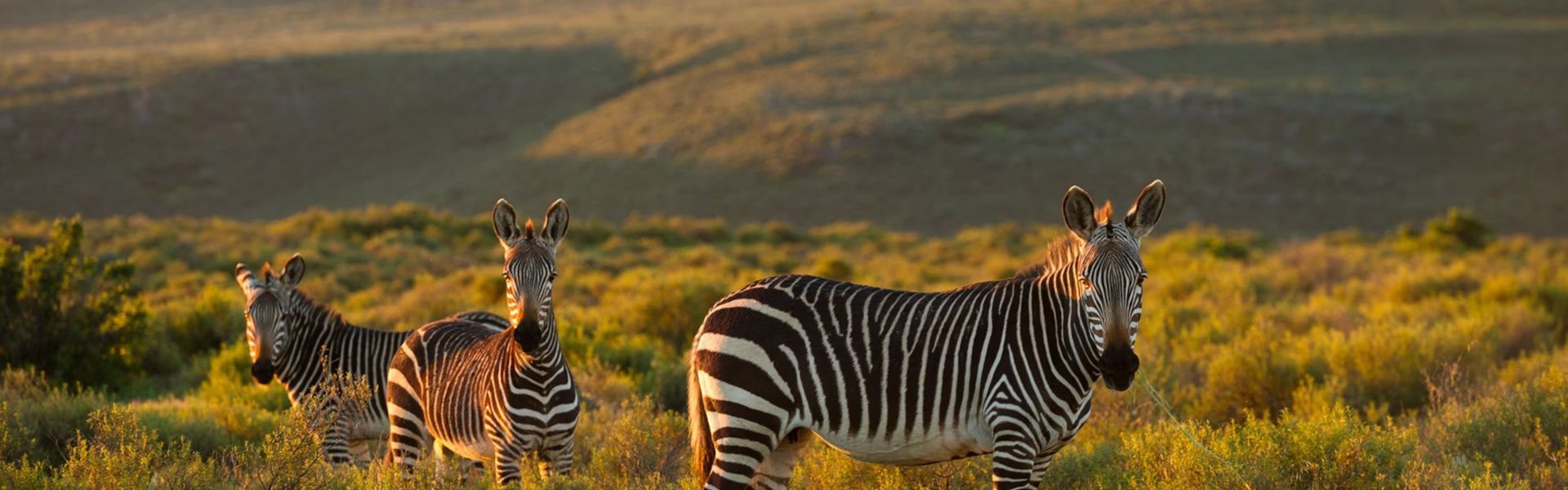

Ultimate Guide to Mountain Zebra Safari
Find Mountain Zebra Safari Tours from Verified South Africa Operators
The Ultimate Guide to Mountain Zebra Safari
Mountain Zebra SafariMountain Zebra National Park, located in the Eastern Cape province of South Africa, was established in July 1937 to protect the endangered Cape mountain zebra. Covering 284 km² today, it is surrounded by the vast Mountain Zebra-Camdeboo Protected Environment, which spans over 896,000 hectares. The park is celebrated for its conservation success, having saved the Cape mountain zebra from near extinction, while also reintroducing large predators and expanding its biodiversity.
History
In the early 1930s, the Cape mountain zebra was on the brink of extinction. To protect the species, the National Parks Board purchased the farm Babylons Toren near Cradock in 1937, proclaiming a 17 km² reserve the following year. At the time, the population consisted of only five stallions and one mare, insufficient for recovery. By 1950, only two stallions remained, but local farmer H.L. Lombard donated eleven zebras, revitalizing the breeding pool. In 1964, the park expanded to 65 km², and further donations increased the population. By the 1970s, numbers had grown to around 140, allowing zebras to be reintroduced to other reserves such as De Hoop Nature Reserve. Since 1978, capture and relocation have been part of routine management, and today the herd exceeds 700 animals. Over time, additional farms were purchased, expanding the park to its current size of 284 km².
Ecology
The park lies within the Karoo biome, characterized by semi-arid grasslands, rocky hills, and valleys. Vegetation includes hardy grasses and shrubs adapted to dry conditions, alongside trees such as Cape beech, Karee, ouhout, olive, Vachellia karroo, and sagewood. The landscape provides grazing for herbivores and habitat for predators, while rivers and seasonal streams sustain biodiversity. The park’s varied terrain supports both plains game and mountain species, making it ecologically diverse.
Wildlife
The park’s flagship species is the Cape mountain zebra, which has been successfully conserved here. Other herbivores include springbok, black wildebeest, red hartebeest, eland, blesbok, mountain reedbuck, gray rhebok, kudu, steenbok, and klipspringer. Cape buffalo were reintroduced in 1998, while gemsbok and south-western black rhino followed in 2002. Predators have also been reintroduced: cheetahs in 2007, brown hyenas in 2008, and lions in 2013, all of which are now breeding successfully. Smaller carnivores such as caracals remain common. Birdlife is diverse, with species such as blue crane, ostrich, blue korhaan, pale chanting goshawk, and kingfishers.
Surrounding Areas
Mountain Zebra National Park is located near the town of Cradock, which serves as the main gateway. The surrounding Mountain Zebra-Camdeboo Protected Environment provides ecological connectivity and ensures broader conservation of the Karoo landscape. The area is rich in cultural and natural heritage, with opportunities to explore both wildlife and historical sites.
Activities
Game drives – Explore the park’s diverse habitats to see zebras, antelope, buffalo, and predators. Morning and evening drives offer the best chances for sightings.
Hiking trails – Approximately 39 km of trails allow visitors to experience the park on foot, with overnight huts available for multi-day treks.
Birdwatching – With cranes, korhaans, raptors, and smaller bushveld species, the park is a rewarding destination for bird enthusiasts.
Photography – Capture the dramatic Karoo landscapes, mountain zebras, and reintroduced predators in their natural environment.
Cultural experiences – Learn about the park’s conservation history and its role in saving the Cape mountain zebra from extinction.
Swimming and relaxation – Overnight guests can enjoy the swimming pool and picnic areas within the park.
Best Time to Visit
Dry season (May–September) – Best for game viewing, as animals gather at water sources and vegetation is sparse.
Wet season (October–April) – The park becomes green and scenic, bird activity peaks, and newborn animals are visible.
Transitional months (April and October) – Offer moderate temperatures and a balance between wildlife visibility and comfort.
Visitor Tips
Plan accommodation – Options include family cottages, a guest house, camping sites, and overnight hiking huts; book early during peak seasons.
Pack for climate extremes – Summers can be hot, while winter nights are cold; layered clothing is essential.
Bring binoculars and cameras – Birding and wildlife photography are highlights, especially for rare species like the Cape mountain zebra.
Respect conservation rules – Stick to designated roads and trails to protect sensitive habitats and species.
Explore beyond game drives – Hiking trails and cultural experiences provide deeper engagement with the park.
Visit nearby Cradock – The town offers additional facilities and serves as a convenient base for exploring the region.