
The Ultimate Guide to Mikumi Safaris

Mikumi National Park stands as a compelling testament to Tanzania's rich biodiversity, offering an unparalleled safari experience that seamlessly blends accessibility with authentic wilderness. Recognized as a "safari paradise," it has emerged as a popular choice for both local and international visitors seeking a convenient yet profound connection with African wildlife.
Established in 1964, Mikumi is Tanzania's fourth-largest national park, encompassing approximately 3,230 square kilometers. Its strategic geographical placement and varied ecosystems position it as a crucial component of the expansive Selous ecosystem, functioning as a vital wildlife corridor and a sanctuary for a diverse array of species.
The park's high degree of accessibility has significantly shaped its trajectory and its role in regional conservation. Situated merely 300 kilometers west of Dar es Salaam along the Dar-Mbeya highway, its convenient location has transformed it into a key destination for both local and international tourists.
This ease of access has directly contributed to the park's rising popularity, translating into increased visitor numbers. This influx of visitors, in turn, generates crucial revenue that can be reinvested into conservation initiatives, infrastructure enhancements, and local community development, aligning with Mikumi's stated mission to promote sustainable tourism that benefits both local populations and the environment.
The park thus exemplifies a model where convenient access not only enhances its appeal but also bolsters its long-term sustainability, offering a contrasting perspective to more remote parks that may face challenges in attracting sufficient visitor numbers and associated funding.
Location and Accessibility.
Mikumi National Park is strategically positioned in central Tanzania, approximately 283 km to 300 km west of Dar es Salaam, along the prominent Dar-Mbeya highway. It is located in close proximity to the city of Morogoro, nestled between the Uluguru Mountains to the northeast and the Rubeho Mountains to the southwest.
The park's prime geographical placement makes it one of Tanzania's most accessible national parks. Visitors can conveniently reach it by road from Dar es Salaam, a journey typically taking three to four hours over scenic landscapes with generally good road conditions.
For a more efficient travel option, an airstrip near the park headquarters accommodates charter flights. Mikumi's strategic position extends beyond its immediate boundaries, as it is an integral part of a much larger ecosystem centered on the vast Selous Game Reserve. The park shares a border and its game populations with Selous, facilitating the movement of wildlife between these protected areas and enriching Mikumi's biodiversity.
This ecological connection means that the vitality of the Selous ecosystem directly influences the wildlife richness observed within Mikumi. Furthermore, Mikumi serves as a crucial gateway to other destinations within Tanzania's southern circuit, including Ruaha, Udzungwa, and Katavi.
This "gateway" effect means that Mikumi often serves as a primary entry point or an introductory experience for travelers embarking on a southern circuit exploration. Its accessibility and ecological link to Selous can encourage visitors to extend their journey to explore the larger, more remote Selous or other parks in the region.
This interconnectedness implies that conservation efforts within Mikumi contribute to the broader health of the Selous ecosystem and vice versa. Mikumi's success, therefore, provides a foundational element for wider regional tourism and conservation strategies, extending its significance beyond its physical borders.
A Tapestry of Landscapes.
Mikumi National Park is characterized by a rich mosaic of landscapes, each contributing to its remarkable biodiversity and offering distinct viewing opportunities.
Mikumi National Park boasts a diverse "tapestry of landscapes ,"The park is bisected by a road, creating distinct environments north-west and south-east. The north-west features the Mkata River basin with savannah, acacia, baobab, and palm trees, while the south-east is less accessible with different wildlife.
Mkata River Floodplain.
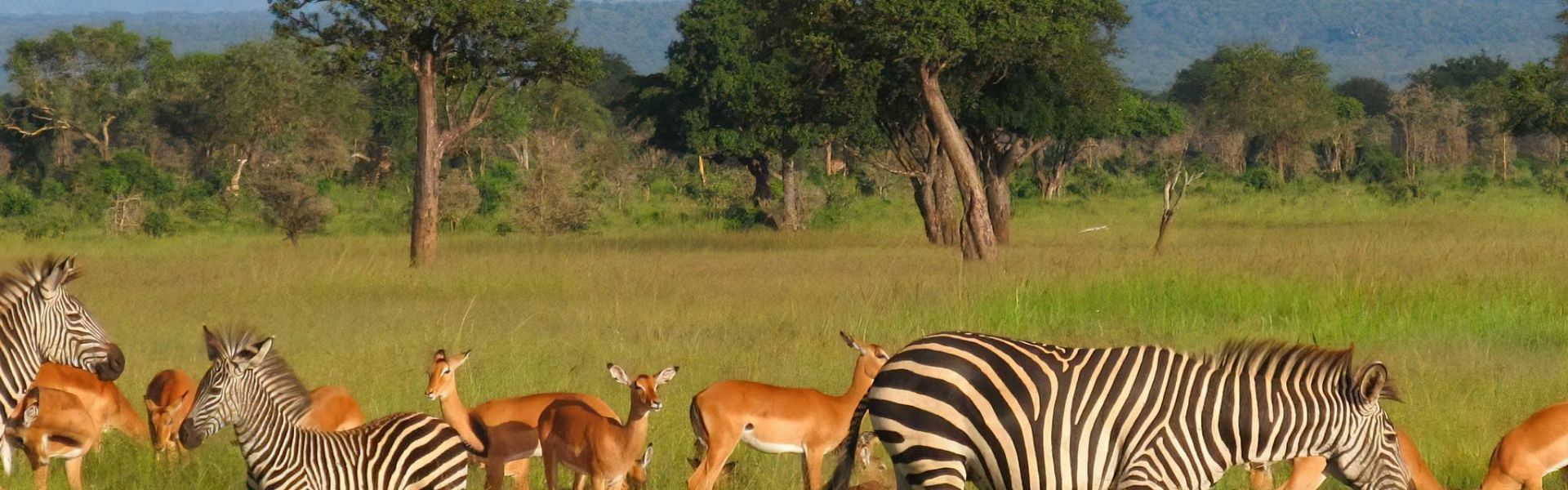
The heart of the park, this area is characterized by open savannah, ideal for spotting large herds of herbivores like zebras, wildebeest, and giraffes.
Woodlands.
Dotted throughout the park, these areas offer a different habitat, with acacia, baobab, and tamarind trees providing shade and shelter for various animals
Rocky Formations.
In the far north-west, the park borders the Rubeho and Uluguru mountains, creating a striking contrast to the plains.
Water Sources.
Artificial pools near the park's northern edge attract hippos and other wildlife, offering excellent viewing opportunities.
Diverse Habitats.
The varying landscapes support a wide range of animal species, including lions, elephants, leopards, and over 400 bird species.
The Mkata Floodplain.
It's a vast, open grassland frequently compared to the Serengeti, known for its abundant wildlife and impressive views.The floodplain is a prime location for game drives, offering excellent opportunities to spot lions, elephants, giraffes, buffalo, zebras, wildebeest, and impala.
Conclusion.
Mikumi National Park is located in south-central Tanzania, approximately 300km west of Dar es Salaam, making it one of the most accessible national parks in the country. It's situated along the major Dar es Salaam-Mbeya highway, making it easily reachable by road from various cities.
The park is also near Morogoro, about 107km away, and borders the Selous Game Reserve.